




India has been undergoing a silent protest-cum-demand, yet voices were heard across the nation especially in the North-Eastern region of the country for a separate time-zone other than UTC+5:30 hours. This demand resonated across the North-Eastern region inclusive of all the seven states (viz., Arunachal Pradesh, Nagaland, Manipur, Mizoram, Tripura, Meghalaya, and Assam) and part of Sikkim and West Bengal.
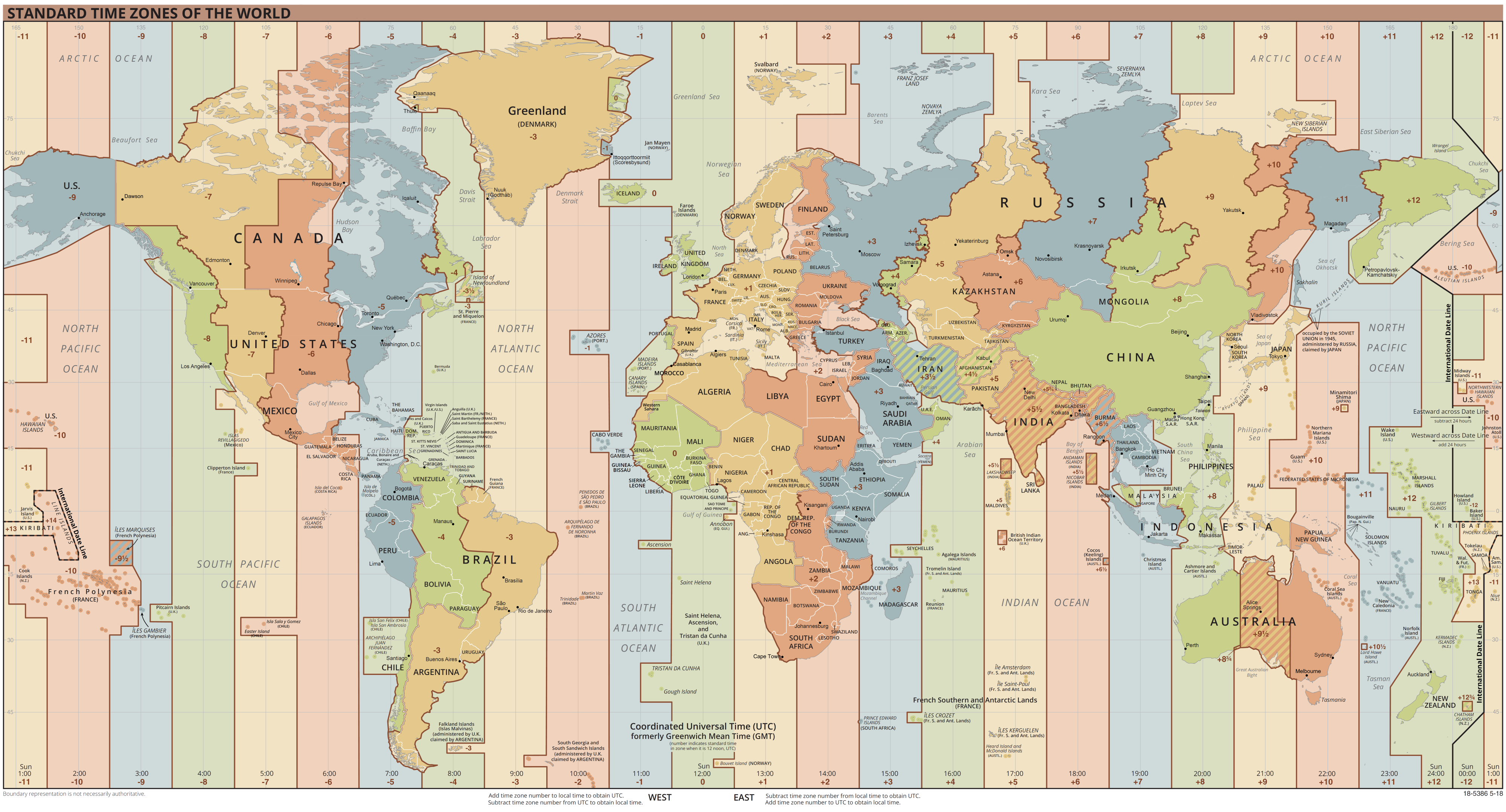
Earlier in 2018, Council of Scientific and Industrial Research’s National Physical Laboratory (CSIR-NPLI) which maintains the Indian Standard Time (IST) has published a research article explaining the need for two time-zones in India.
- The worldwide system of time zones was proposed by a Scottish-Canadian Engineer, Sir Sandford Fleming, in 1879.
- Eventually in 1884, the International Meridian Conference adopted a 24-hour day.
- Countries across the world keep different times due to Earth’s rotation and revolution around the Sun.
- As Earth turns 15 degree around its axis, time changes by one hour. A 360 degree rotation yields 24 hours.
- As a result, the world id divided into 24 time zones shifted by one hour each.
Though, the people, legislators, and industrialists from North-Eastern part of the country may face problems with the existing Indian Standard Time (IST). The existing IST is experienced to be badly affecting the lives and functioning of the people as the Sun rises and sets much earlier than the official working hours by the time offices or educational institutions open and closes. In winter, this problem gets even more severe as the Sun sets much early and therefore, more consumption of electricity is required to keep life active. Recently, the Hon’ble High Court of Gauhati dismissed a public interest litigation (PIL) which seek a separate time zone for Northeast.
The scientific reasoning remains perfectly valid and present the most compelling arguments for the need and requirement of two time-zones for India. But the same argument could also be made the people, legislators, and industrialist from the state of Gujarat and parts of Rajasthan and Maharashtra, that the Sun rises and sets late for them and hence, why the need to start the day early.
Time zones in India were first set up in 1884, during the British Raj. Before independence, India followed three major time zones, Bombay, Calcutta, and Madras Time. Indian Standard Time is an anachronism like many systems that were inherited from the British. It was in 1906 that India had a single IST running through the center of the country. The Indian Standard Time (IST) is based on a longitude of 82.50E which passes through Mirzapur, near Prayagraj (Allahabad) in Uttar Pradesh. It is 5 hours 30 minutes ahead of Greenwich Mean Time (GMT), as contemporarily known as Universal Coordinated Time (UTC). The CSIR-NPLI (New Delhi) is the keeper of the time in India. It records time using five Cesium atomic clocks.
India would save 2.7 billion units of electricity every year by shifting the IST meridian eastward (from longitude 82.5E to 90.0E near the Assam-Bengal border). India stands to gain little and could in fact suffer from negative energy saving if two time zones are introduced. Advancing IST by 30 minted saves more electricity than the corresponding proposals for introducing daylight saving time or introducing two time zones in the country staggered by one hour.
CSIR’s suggestion: In 2006, the erstwhile Planning Commission (now NITI Aayog) recommended the division of the country into two time zones. CSIR-NPL has supported the long-standing demand and has suggested two IST’s separated by difference of one hour:
– IST-I for most India (Between 68(deg) 7’E to 89(deg) 52’E).
– IST-II for the Northeastern region (Between 89 (deg) 52’E to 97(deg) 25’E).
The main advantage of IST-II is making the circadian rhythm synchronous to the solar day which would enhance the efficiency of people working in the region and hence, the overall productivity. In addition, due to better use of daylight, one can expect that a good amount of electricity will also be saved in this region with the introduction of IST-II.
What is Circadian Rhythm?
– Circadian rhythm is the 24-hour cycle that tells our bodies when to sleep, rise, and eat; regulating many physiological processes.
– Internal body clock is affected by environmental cues like sunlight and temperature, and determines whether one feels wide-awake and energized or tired.
– Jeffrey C. Hall, Michael Rosbash, and Michael W. Young – studied the molecular mechanisms controlling circadian rhythm. They were awarded the 2017 Nobel Prize in Physiology/Medicine.
By these reasoning, the people of Scandinavian countries should shut down their businesses, manufacturing, production, functioning, and operations, and just sleep during the wintertime, as they merely see the light during the day. Most regions in these countries do not see daylight for about six months or so. Wondering about their circadian rhythm synchronous to the solar day. Does their bodes have solar light storage capacity that allows them to function during the winter season? They might be small countries (in comparison to land area) but the magnitude of problem they might suffer will be gigantic and we don’t see them complaining to the Sun or the Moon or the Earth or to the geographic location of their country.
The Hon’ble Prime Minister of India today makes it crystal clear through his ‘One Nation, One Time’ initiative that the country will follow one time zone viz., UTC+5:30 hours. The Legal Metrology (Indian Standard Time) Rules, 2024, have been drafted and will be gazette soon via., the Department of Consumer Affairs, Ministry of Consumer Affairs, Food, and Public Distribution, Government of India.
India needs to focus on increasing productivity, being rightly and properly educated, making ourselves employable, and contributing to the betterment of the nation by serving the nation through working for the welfare of the nation, be it economic or social or both.
The Legal Metrology (Indian Standard Time) Rules, 2024, aims to establish a legal framework for standardizing timekeeping practices, mandating IST as the sole time reference for legal, administrative, commercial, and official documents. Key provisions include prohibition of time references other than IST for official and commercial purposes, mandatory display for IST in government offices and public institutions and requirement for time-synchronization systems to ensure reliability, availability, and cybersecurity.
The proposal comes as part of efforts to ensure precise timekeeping in critical national infrastructure including telecommunications, banking, defence, and emerging technologies like 5G and artificial intelligence.
The department of Consumer Affairs is collaborating with the National Physical Laboratory and Indian Space Research Organization (ISRO) to develop a robust time generation and dissemination mechanism. Violations of the proposed rules will attract penalties, with periodic audits planned to ensure compliance across sectors.
 Naman Jain