




Sustainable Development Goal 11 (SDG 11 or Global Goal 11), titled “sustainable cities and communities”, is one of 17 Sustainable Development Goals established by the United Nations General Assembly in 2015. The official mission of SDG 11 is to “Make cities inclusive, safe, resilient and sustainable”. The 17 SDGs take into account that action in one area will affect outcomes in other areas as well, and that development must balance social, economic and environmental sustainability.
SDG 11 has 10 targets to be achieved, and this is being measured with 15 indicators. The seven outcome targets include safe and affordable housing, affordable and sustainable transport systems, inclusive and sustainable urbanization, protection of the world’s cultural and natural heritage, reduction of the adverse effects of natural disasters, reduction of the environmental impacts of cities and to provide access to safe and inclusive green and public spaces. The three means of implementation targets include strong national and regional development planning, implementing policies for inclusion, resource efficiency, and disaster risk reduction in supporting the least developed countries in sustainable and resilient building.
3.9 billion people—half of the world’s population—currently live in cities globally. It is projected that 5 billion people will live in cities by 2030. Cities across the world occupy just 3 percent of the Earth’s land, yet account for 60–80 percent of energy consumption and 75 percent of carbon emissions. There are serious challenges for the viability and safety of cities to meet increased future demands.
Background
SDG 11 addresses slums, human settlement management and planning, climate change mitigation and adaptation, and urban economies. Prior to the adoption of the 2030 Agenda, Millennium Development Goal 7, target 4, called for efforts to achieve a “significant improvement in the lives of at least 100 million slum dwellers” by 2020.
There has been a rapid growth of mega-cities, especially in the developing world: “In 1990, there were ten mega-cities with 10 million inhabitants or more, and in 2014, there were 28 mega-cities, home to a total of 453 million people”. With regards to slums, data shows that “828 million people live in slums today and most them are found in Eastern and South-Eastern Asia”.
SDG 11 represents “a shift in international development cooperation from a focus on poverty as a rural phenomenon to recognizing that cities, especially in the global south, are facing major challenges with extreme poverty, environmental degradation and risks due to climate change and natural disasters”.
| Targets | Indicator(s) |
|---|---|
| 11.1 By 2030, ensure access for all to adequate, safe and affordable housing and basic services and upgrade slums | 11.1.1 Proportion of urban population living in slums, informal settlements or inadequate housing |
| 11.2 By 2030, provide access to safe, affordable, accessible and sustainable transport systems for all, improving road safety, notably by expanding public transport, with special attention to the needs of those in vulnerable situations, women, children, persons with disabilities and older persons | 11.2.1 Proportion of population that has convenient access to public transport, by sex, age and persons with disabilities |
| 11.3 By 2030, enhance inclusive and sustainable urbanization and capacity for participatory, integrated and sustainable human settlement planning and management in all countries | 11.3.1 Ratio of land consumption rate to population growth rate 11.3.2 Proportion of cities with a direct participation structure of civil society in urban planning and management that operate regularly and democratically |
| 11.4 Strengthen efforts to protect and safeguard the world’s cultural and natural heritage | 11.4.1 Total per capita expenditure on the preservation, protection and conservation of all cultural and natural heritage, by source of funding (public, private), type of heritage (cultural, natural) and level of government (national, regional, and local/municipal) |
| 11.5 By 2030, significantly reduce the number of deaths and the number of people affected and substantially decrease the direct economic losses relative to global gross domestic product caused by disasters, including water-related disasters, with a focus on protecting the poor and people in vulnerable situations | 11.5.1 Number of deaths, missing persons and directly affected persons attributed to disasters per 100,000 population 11.5.2 Direct economic loss in relation to global GDP, damage to critical infrastructure and number of disruptions to basic services, attributed to disasters |
| 11.6 By 2030, reduce the adverse per capita environmental impact of cities, including by paying special attention to air quality and municipal and other waste management | 11.6.1 Proportion of municipal solid waste collected and managed in controlled facilities out of total municipal waste generated, by cities 11.6.2 Annual mean levels of fine particulate matter (e.g. PM2.5 and PM10) in cities (population weighted) |
| 11.7 By 2030, provide universal access to safe, inclusive and accessible, green and public spaces, in particular for women and children, older persons and persons with disabilities | 11.7.1 Average share of the built-up area of cities that is open space for public use for all, by sex, age and persons with disabilities 11.7.2 Proportion of persons victim of physical or sexual harassment, by sex, age, disability status and place of occurrence, in the previous 12 months |
| 11.a Support positive economic, social and environmental links between urban, peri-urban and rural areas by strengthening national and regional development planning | 11.a.1 Number of countries that have national urban policies or regional development plans that (a) respond to population dynamics; (b) ensure balanced territorial development; and (c) increase local fiscal space |
| 11.b By 2020, substantially increase the number of cities and human settlements adopting and implementing integrated policies and plans towards inclusion, resource efficiency, mitigation and adaptation to climate change, resilience to disasters, and develop and implement, in line with the Sendai Framework for Disaster Risk Reduction2015–2030, holistic disaster risk management at all levels | 11.b.1 Number of countries that adopt and implement national disaster risk reduction strategies in line with the Sendai Framework for Disaster Risk Reduction 2015–2030 11.b.2 Proportion of local governments that adopt and implement local disaster risk reduction strategies in line with national disaster risk reduction strategies |
| 11.c Support least developed countries, including through financial and technical assistance, in building sustainable and resilient buildings utilizing local materials | No suitable replacement indicator was proposed. The global statistical community is encouraged to work to develop an indicator that could be proposed for the 2025 comprehensive review. See E/CN.3/2020/2, paragraph 23 |
Custodian agencies
The custodian agencies are responsible for data gathering and reporting on the indicators:
- For the indicators of Targets 11.1, 11.2 and 11.3 and also for Indicator 11.a.1 and Indicator 11.c.1: United Nations Human Settlements Programme (UN-HABITAT)
- For Indicator 11.4.1: United Nations Educational, Scientific, and Cultural Organization-Institute for Statistics (UNESCO-UIS)
- For the two indicators under Target 11.5 and for Indicator 11.b.2: United Nations International Strategy for Disaster Reduction (UNISDR)
- For Indicator 11.6.1: United Nations Human Settlements Programme (UN-HABITAT), Department of Economic and Social Affairs (DESA) and UNSD
- For Indicator 11.6.2: World Health Organization
Organizations
UN system
- United for Smart Sustainable Cities Initiative (U4SSC) which has been pilot to monitor urban environment related Sustainable Development Goals (SDGs) projects
- Inter-American Development Bank (IDB)
- UN Industrial Development Organization (UNIDO)
- UN Economic Commission for Africa (ECA)
- United Nations International Strategy for Disaster Reduction (UNISDR)
- United Nations Human Settlements Programme.
Major NGOs
The following NGOs and other organizations are helping to achieve SDG 11:
- C40 cities is a network of the world’s megacities committed to addressing climate change, it is taking bold climate action and leading the way towards having a more sustainable future. C40 also offers cities an effective forum to collaborate, share knowledge and drive meaningful action on climate change.
- ICLEI is committed to sustainable urban development. It helps members to make their cities and regions sustainable, low-carbon, resilient, ecomobile, biodiverse, resource-efficient and healthy, with a green economy and smart infrastructure.
- 100RC developed by the Rockefeller Foundation helps cities around the world to become more resilient to physical, social, and economic shocks and stresses and it supports the adoption and incorporation of a view of resilience that includes not just the shocks, earthquakes, fires, floods, but also the stresses that weaken the fabric of a city on a day to day or cyclical basis.
Interlinkages with other SDGs
Goal 11 has wide ranging inter-linkages with other SDGs and development agendas such as the New Urban Agenda and the Sendai Framework. The majorities of the 234 SDG indicators are linked to urban policy and have a direct influence on cities and human settlements. Nearly a third of indicators are also monitored at the local level. Access to land, slums, and insufficient housing are all connected to poverty; and gender equality can benefit from access to public spaces, basic infrastructure, and participation in local government and decision-making. Urban waste management is strongly associated with safe drinking water, sanitation and hygiene; energy systems are critical for the development of safe, resilient and sustainable human settlements; and inclusive and productive cities are important for entrepreneurship and job creation. Similarly, resilient infrastructure and industrialization are essential for the prosperity of cities; intra-city and spatial inequalities are fundamental for understanding and addressing the goal on inequalities; and the efficient management of natural resources, safe disposal and treatment of toxic waste and pollutants can contribute to health, as well as responsible consumption and production.
Thus, it can be comprehended that most SDGs are interconnected in some way, and their implementation at the local, national, and global levels should be coordinated to achieve sustainable development. SDG-11 is directly linked to targets and indicators in at least ten other SDGs.
The goal of cities and communities offers many opportunities to develop mitigation and adaptation strategies to address climate change, especially through environmentally sustainable and resilient urban development. The promotion of peaceful and inclusive societies requires cities free of violence and with a rule of law. Hence, understanding the urban dimension of the different sustainable development goals is a key to unlocking their full potential.
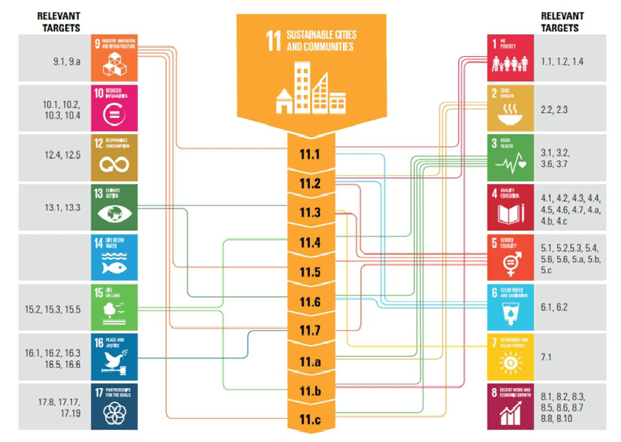
Source: SDG 11 syntheis report, HLPF 2018
Implementation of goal in India
The Indian government is dedicated to reaching the 17 Sustainable Development Goals. The National Institution for Transforming India (NITI Aayog) has been tasked with overseeing the implementation of SDGs in the country at the central government level. The development of baseline data for the National Indicator Framework is the responsibility of the Ministry of Statistics and Program Implementation (MoSPI). For the adoption, implementation, and monitoring of the SDG agenda, NITI Aayog works closely with the MoSPI, all central ministries, state/union territory governments, international development agencies such as the UN, think tanks, and civil society groups. As the involvement of states has been acknowledged as critical to the agenda’s achievement, NITI Aayog has been holding biannual state level discussions with states/UTs since 2017.
The NITI Aayog has been assisting states/UTs in establishing monitoring systems at the state and district levels. The majority of states and UTs have aligned their government’s schemes, programmes, and policies with the SDG objectives, delegating target duty to their various ministries. To track success at the state level, the MoSPI has published recommendations for all states/UTs to create their own State Indicator Framework. States are also urged to create their own District Indicator Framework and District Index to rank their districts’ performance and stimulate healthy competition.
Despite the progress that has been achieved at a global level in recent years to help guide and drive local, national and regional processes on sustainable development, many challenges still exist that might hinder the SDG-11 implementation process. Efforts to localize the SDGs have so far been made at the state level, with no attempt to localize them at the municipal level posing as one of the challenges in its implementation. While rules are established at the state level, numerous goals must be met at the local level. This is especially true for SDG-11 ‘s goal. Localizing SDG-11 measures require new relationships between various levels of government, as well as the creation of new network spheres of authorities, which will test the conventional interaction between local, national, regional, and global levels. Furthermore, cities play a larger role in the local development of natural resource planning and management, with better access to resources and a more decentralized governance structure, in order to actively contribute to the achievement of the SDGs, notably SDG-11.
National governments should collaborate closely with local governments and communities to include SDG-11 into development processes. This will also help to renew and design their cities and human settlements in order to promote community cohesion, personal security, and innovation and employment. All local and national authorities, including land-use planning, urban agriculture, water resource management, energy-related authorities, employment opportunities, technology, transportation infrastructure development, socio economic development , waste management, and so on, must work together to achieve sustainable urban development.
Another challenge is measuring the progress of the goals. Measuring progress necessitates reporting at many governance levels, including the United Nations, as well as national and municipal governments. As a result, it is critical to address the issue of capability and resources globally, including all member states. Some nations, for example, are unable to gather data, while others collect incorrect data; others are unable to analyze the data they collect, while yet others lack reporting mechanisms. This becomes considerably more difficult when we are not assessing change within communities, but within countries, regions and across the world.
Some Facts related to India for SDG Goal 11 (source: UN, India)
- By 2030 India will have 7 Mega-cities with population over 10 million
31 % live in Urban areas - 17 % of urban population lives in slums
- 62 million tonnes per annum waste generated in cities
- 1.2 million people died of pollution related diseases in 2017
- 13 % of urban households don’t have sanitary toilets, and 16.7 % don’t have bathroom facilities
100 cities under Smart Cities Mission of Government of India which started in 2015 are completing five years and are being evaluated on three parameters,
- Ease of living,
- Municipal performance index,
- Climate.
Ease of living will reflect aspects such as citizens’ perception (30%), quality of life (35%), sustainability (20%), economic ability (15%), and sub factors such as education, health, housing, mobility, safety, development. The main aim to develop 100 urban cities into smart cities across the country is to make them citizen-friendly, sustainable, and environment, climate responsive.
FOR MORE DETAIL DISCUSSION ON SDG 11 – SUSTAINABLE CITIES AND COMMUNITIES, LISTEN TO THE PODCAST EPISODE ON ‘RESEARCH WITH NJ’.
 Naman Jain