




Sustainable Development Goal 16 (SDG 16 or Global Goal 16) is one of the 17 Sustainable Development Goals established by the United Nations in 2015, the official wording is: “Promote peaceful and inclusive societies for sustainable development, provide access to justice for all and build effective, accountable and inclusive institutions at all levels”. The Goal has 12 targets and 23 indicators.
SDG 16 has ten outcome targets: Reduce violence; protect children from abuse, exploitation, trafficking and violence; promote the rule of law and ensure equal access to justice; combat organized crime and illicit financial and arms flows, substantially reduce corruption and bribery; develop effective, accountable and transparent institutions; ensure responsive, inclusive and representative decision-making; strengthen the participation in global governance; provide universal legal identity; ensure public access to information and protect fundamental freedoms. There are also two means of implementation targets: Strengthen national institutions to prevent violence and combat crime and terrorism; promote and enforce non-discriminatory laws and policies.
Background
The Sustainable Development Goals are a collection of 17 global goals set by the United Nations. The goals are interrelated though each has its own targets to achieve. The SDGs cover a broad range of social and economic development issues.
SDG 16 addresses the need to promote peace and inclusive institutions. Areas of improvement include for example: reducing lethal violence, reducing civilian deaths in conflicts, and eliminating human trafficking.
Several of the SDGs and targets focus on marginalized people and “seek to increase inclusiveness and to foster justice”. SDG 16 has a strong focus on inclusive societies and institutions. At the global level, SDG 16 could have steering effects on inclusiveness in global governance, in particular for the least developed countries. However, a meta-analysis in 2022 has shown that “rhetoric and action do not match when it comes to the impacts of the Sustainable Development Goals on inclusiveness within and between countries”.
| Targets | Indicator(s) |
|---|---|
| 16.1 Significantly reduce all forms of violence and related death rates everywhere | 16.1.1 Number of victims of intentional homicide per 100,000 population, by sex and age 16.1.2 Conflict-related deaths per 100,000 population, by sex, age and cause 16.1.3 Proportion of population subjected to (a) physical violence, (b) psychological violence and (c) sexual violence in the previous 12 months 16.1.4 Proportion of population that feel safe walking alone around the area they live |
| 16.2 End abuse, exploitation, trafficking and all forms of violence against and torture of children | 16.2.1 Proportion of children aged 1–17 years who experienced any physical punishment and/or psychological aggression by caregivers in the past month 16.2.2 Number of victims of human trafficking per 100,000 population, by sex, age and form of exploitation 16.2.3 Proportion of young women and men aged 18–29 years who experienced sexual violence by age 18 |
| 16.3 Promote the rule of law at the national and international levels and ensure equal access to justice for all | 16.3.1 Proportion of victims of violence in the previous 12 months who reported their victimization to competent authorities or other officially recognized conflict resolution mechanisms 16.3.2 Unsentenced detainees as a proportion of overall prison population 16.3.3 Proportion of the population who have experienced a dispute in the past two years and who accessed a formal or informal dispute resolution mechanism, by type of mechanism |
| 16.4 By 2030, significantly reduce illicit financial and arms flows, strengthen the recovery and return of stolen assets and combat all forms of organized crime | 16.4.1 Total value of inward and outward illicit financial flows (in current United States dollars) 16.4.2 Proportion of seized, found or surrendered arms whose illicit origin or context has been traced or established by a competent authority in line with international instruments |
| 16.5 Substantially reduce corruption and bribery in all their forms | 16.5.1 Proportion of persons who had at least one contact with a public official and who paid a bribe to a public official, or were asked for a bribe by those public officials, during the previous 12 months 16.5.2 Proportion of businesses that had at least one contact with a public official and that paid a bribe to a public official, or were asked for a bribe by those public officials during the previous 12 months |
| 16.6 Develop effective, accountable and transparent institutions at all levels | 16.6.1 Primary government expenditures as a proportion of original approved budget, by sector (or by budget codes or similar) 16.6.2 Proportion of population satisfied with their last experience of public services |
| 16.7 Ensure responsive, inclusive, participatory and representative decision-making at all levels | 16.7.1 Proportions of positions in national and local institutions, including (a) the legislatures; (b) the public service; and (c) the judiciary, compared to national distributions, by sex, age, persons with disabilities and population groups 16.7.2 Proportion of population who believe decision- making is inclusive and responsive, by sex, age, disability and population group |
| 16.8 Broaden and strengthen the participation of developing countries in the institutions of global governance | 16.8.1 Proportion of members and voting rights of developing countries in international organizations |
| 16.9 By 2030, provide legal identity for all, including birth registration | 16.9.1 Proportion of children under 5 years of age whose births have been registered with a civil authority, by age |
| 16.10 Ensure public access to information and protect fundamental freedoms, in accordance with national legislation and international agreements | 16.10.1 Number of verified cases of killing, kidnapping, enforced disappearance, arbitrary detention and torture of journalists, associated media personnel, trade unionists and human rights advocates in the previous 12 months 16.10.2 Number of countries that adopt and implement constitutional, statutory and/or policy guarantees for public access to information |
| 16.a Strengthen relevant national institutions, including through international cooperation, for building capacity at all levels, in particular in developing countries, to prevent violence and combat terrorism and crime | 16.a.1 Existence of independent national human rights institutions in compliance with the Paris Principles |
| 16.b Promote and enforce non-discriminatory laws and policies for sustainable development | 16.b.1 Proportion of population reporting having personally felt discriminated against or harassed in the previous 12 months on the basis of a ground of discrimination prohibited under international human rights law |
Custodian agencies
Custodian agencies are responsible for monitoring and reporting of indicators:
- Indicator 16.1.1: United Nations Office on Drugs and Crime (UNODC) and World Health Organisation (WHO).
- Indicator 16.1.2: Office of the UN High Commissioner for Human Rights (OHCHR)
- Indicator 16.1.3 and 16.1.4: United Nations Office on Drugs and Crime (UNODC)
- Indicator 16.2.1 and 16.2.3: United Nations Children’s Emergency Fund (UNICEF)
- Indicators 16.2.2, 16.3.2 and 16.5.1: United Nations Office on Drugs and Crime (UNODC)
- Indicator 16.4.1: United Nations Office on Drugs and Crime (UNODC), and United Nations Conference on Trade and Development (UNTAD)
- Indicator 16.4.2: United Nations Office on Drugs and Crime (UNODC), and United Nations Office for Disarmament Affairs
- Indicator 16.5.2: World Bank (WB) and United Nations Office on Drugs and Crime (UNODC)
- Indicator 16.6.1: World Bank (WB)
- Indicator 16.6.2 and for two indicators under Target 16.7: United Nations Development Programme (UNDP)
- Indicator 16.8.1: Department of Economic and Social Affairs-Financing for Development Office (DESA/FFDO)
- Indicator 16.9.1: Department of Economic and Social Affairs-Statistics Division (DESA/UNSD) and United Nations Children’s Emergency Fund (UNICEF)
- Indicator 16.10.1, 16.a.1 and 16.b.1: Office of the UN High Commissioner for Human Rights (OHCHR)
- Indicator 16.10.2: United Nations Educational, Scientific, and Cultural Organization (UNESCO)
Links with other SDGs
The Sustainable Development Goals are not taken as being completely independent one from the other, but rather as being closely linked. In this way, media development enhances freedom of speech, peace, but also contributes to sustainability, poverty eradication and human rights. Fostering peace and inclusive societies can help reduce inequalities (SDG10) and help economies prosper (SDG8). The 2012 outcome document of the United Nations Summit on the 2030 Agenda considers that sustainable development cannot be achieved without building peaceful, just and inclusive societies and addressing issues of corruption, poor governance, insecurity and injustice.
Organizations
The United Nations Development Programme (UNDP) is the United Nations global development network which is concerned with SDG 16. Hence, the Program focuses on democratic governance and peace building. The UNDP also works on conflict prevention by empowering youth, especially women. Also, they aim at supporting the frameworks and structure and by acting as mediators.
Achievement of India in Sustainable Development Goals
While formulating the action plan towards achieving the SDGs, India has kept in mind the following:
- Interconnectedness of problems: Problems relating to development are not limited to national boundaries only; these development issues are increasingly becoming global in nature. Impact generated in one country spreads to others.
- Multidimensional Approach: India has adopted multidimensional approach spread over 169 targets. A separate Goal -Goal 16 on peaceful societies and effective institutions. A stand-alone goal-Goal 17 on global partnership has been included to provide financial, technological and systemic support to the developing nations.
- Means of lmplementation: It has kept provision for financial resources for capacity building, eco -friendly technologies, and also for data generation and management.
- System of Monitoring and Review: In consonance with the U.N. Resolution that underlines the importance of follow up at the national, regional and global levels, India has been according special priority to track the progress of development goals and targets. A Global Indicator Framework of 243 indicators has been developed for evaluating the progress of SDGs.
- Voluntary National Reviews: (VNRs) are carried out for sharing the experiences, including successes, challenges and lessons learnt.
India’s Participation in the Formulation of Goals and Targets
As a member of Open Working Group (OWG) constituted for preparing a proposal on the SDGs, India raised the issues of the developing nations and emphasized on the priorities for lifting the conditions of poor people reeling under abject poverty through rapid and inclusive economic growth. India took the position that the SDGs have to be an agenda for development.
Resources are required for main development agenda, and also for capability building to accomplish these tasks. Keeping in view the enormity of tasks, India, laid due emphasis on international cooperation to facilitate development, and adequate means of implementation such as Official Development Assistance (ODA) and technology transfer on favorable terms for helping the developing countries.
INSTITUTIONAL SET UP IN INDIA
NITI Aayog has been entrusted to oversee the implementation of SDGs at the national level. It has carried out mapping of all SDGs, Central Ministries and Centrally sponsored schemes. It is also undertaking national and regional level consultations with stakeholders including States and Union Territories. Besides other documents, NITI Aayog has brought out SDG India Index: Baseline Report 2018; and Localizing SDGs; Early Lessons from India.
1. Monitoring Mechanism- The Index as a ready Reckoner
NITI Aayog is entrusted with twin mandate to oversee the adoption and monitoring of the SDGs in the country and also promote competitive and cooperative federalism among States and Union Territories. The modular nature of index has become a policy tools and a ready reckoner for gauging the progress of States and UTs.
The Ministry of Statistics and Programme Implementation (MoSPI) developed 306 national indicators in line with the 169 SDG targets and Global Indictor Framework. Out of these indicators, 62 priority indicators have also been identified for tracking the important developmental objectives for India.
States and Union Territories are classified as below based on their SDG India Index score:
| Category | Score |
|---|---|
| Aspirant | 0-49 |
| Performer | 50-64 |
| Front-Runner | 65-99 |
| Achiever | 100 |
To measure India’s performance towards Peace, Justice and Strong Institutions, 6 national level indicators were identified. These included:
a) Reported murders per 100,000 populations. b) Crime Against Children per 100,000 population. c) Court Density. d) Corruption Crime Ratio, e) Birth Registered, f) Aadhaar Coverage.
The SDG India Index 2020-21 has been developed. Indicators have been developed by NITI Aayog in consultations with States, Union Territories, UN Agencies in India, MoSPI and key Union Ministries. It tracks the progress of all States and Union Territories on 115 indicators. These indicators have included 16 out of 17 SDGs, with a qualitative assessment on SDG 17 and cover 70 SDG targets. 2018-19, and 2019-20, Editions covered 62 indicators across 39 target and 13 goals, and 100 indicators across 54 targets and 16 goals respectively.
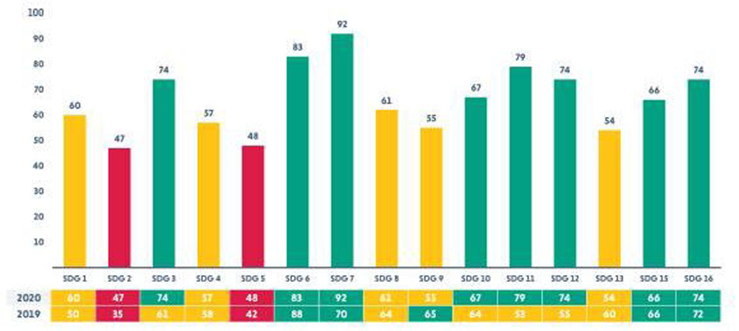
Source: NITI Aayog’s SDG India Index and Dashboard 2020-21
Achievement regarding SDG 16 shows improvement from 72 in 2019 to 74 in 2020. Top State is Uttarakhand and Pudduchery among the Union Territories.
India adopted the methodology consisting of following steps:
– Identification of indicators from NIF based on State-wise acceptability and availability of data.
– Each indicator is assigned a score ranging from 0(denoting worst performance) to 100 (denoting target achievement).
– Equal weight given to each indicator in line with internationally accepted practices.
– Aggregate score of a State is computed by calculating arithmetic mean of normalized values of all indicators.
– Finally overall SDG Index score is calculated by averaging all Goal scores.
States are ranked in respective categories in accordance with score obtained. With regards to SDG 16, marked improvement is seen in the year 2020 as compared to year 2019.
India has taken some noteworthy initiative-Digital India campaign (focused on providing e-governance solutions for citizen-centric projects), the Pragati platform (which is an IT -based redressal and monitoring system), and Right to Information Legislation. The NITI Aayog has identified three centrally sponsored schemes (CSS) that would be monitored to ensure effective implementation of SDG 16. These include:
- Panchayat Yuva Krida aur Khel Abhiyan (PYKKA), development of Infrastructure Facilities for Judiciary including Gram Nyayalayas (for setting up of a new tier of courts- Gram Nyayalayas-providing quick and inexpensive access to justice to citizens).
- Integrated Child Protection Schemes
Actions Needed to Catalyze the Progress of SDG 16
SDG 16 has potential to catalyze the social transformation. All nations are needed to deploy sustained efforts towards peace, access to justice and inclusion for addressing the grave challenges that confront the achievement of SDG16 to the desired degree/level.
Thrusts need to be given, inter-alia, on following aspects.
- Political Commitment and Financial investment: Visionary and committed leadership is essential to accelerate the progress and help in transformation of societies. Commitment and investments can prevent conflicts, address inequality, reduce injustice and pave the way towards inclusiveness.
- Policy Coherence and Institutional mechanism: There must be policy Coherence and Institutional Mechanisms in place at national and local level to gather data and monitor Policy efforts. Investments are needed for reliable generation of inclusive data and data disaggregation to ensure that no one is left behind. Resources available for data collection are limited resulting in data gaps.
- Holistic Approach: Implementation requires fusion of a whole Government and a whole Society Approach for synergistic effects.
- Greater emphasis on protecting the fundamental freedoms: With civic shrinking space, many organizations are facing hurdles in the path of inclusion and participation. There are threats to the personal safety of human rights activists, defenders. Human Rights Monitoring and documentation methodologies are critical resource and provide valuable information, whether states are meeting their Human Rights obligations or not. Hence, the governance institutions and decision making processes need to have a relook and strengthen the systems for protection of human rights.
- Reinvigorating National Human Rights Institutions (NHRIs): Role of NHRIs is critical as they help build trust between government institutions and people and help in promoting transparent, participatory and inclusive national processes of SDG implementation.
FOR MORE DETAIL DISCUSSION ON SDG 16 – PEACE, JUSTICE AND STRONG INSTITUTION, LISTEN TO THE PODCAST EPISODE ON ‘RESEARCH WITH NJ’.
 Naman Jain