




Author: Ms. Richa Agarwal
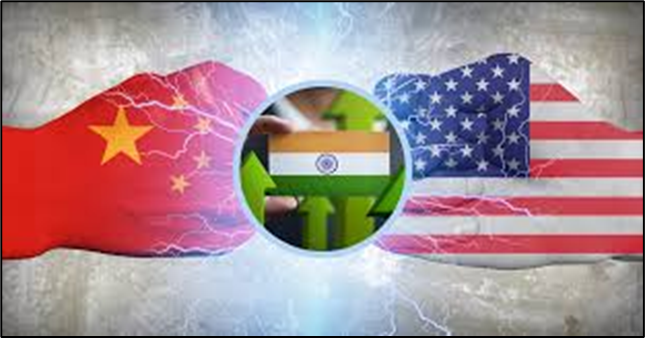
The world is currently experiencing significant advancements, particularly in green energy and artificial intelligence (AI), which are driving innovations across developed, developing, and emerging market economies. A notable development is China’s DEEPSEEK project, an AI initiative that has created considerable concern among developing countries. In contrast, the US-developed OpenAI has been widely accepted due to its established logistics and dominance in the field. Many countries recognize that it will take time for them to create their own platforms for such innovations, and until recently, many companies were hesitant to diversify their capital expenditures. However, with the emergence of China’s technological advancements, countries like India and the US have begun investing in AI research and development. They understand that success in this domain relies not only on robust logistics and human capital but also on strong domestic support, local accessibility, and public awareness. This innovation has highlighted labor-intensive economies the critical ways in which AI can be utilized. In the US, OpenAI operates as a profit-driven business, showcasing its global dominance. In contrast, DEEPSEEK is primarily employed for monitoring purposes within government administration, military operations, and citizen oversight.
If India is planning to invest in artificial intelligence, it should focus on several key areas. With the stagnation in manufacturing growth, AI can be utilized to enhance the efficiency of industries without negatively impacting the labor market. To effectively access both local and global markets, establishing strong logistics and creating robust connections between states and districts is crucial. Instead of relying solely on technology imports from major tech companies, it’s vital for India to not just lay out investment plans but also to analyze the effective usage of these technologies. This includes exploring data monetization, linking regional sectors, and, importantly, providing incentives to startups that are leading the way in such innovations.
In this perspective, the Government of India has launched initiatives that are directly or indirectly linked to the advancement of artificial intelligence. In the recent Budget for FY 2025, an allocation of INR 4,349.75 crores was announced for the development of AI. This funding will be directed towards creating AI models through investments in research and development centers, as well as initiating new software and logistics advancements. To support this initiative, training and skill development will be provided to students in areas such as machine learning and AI modeling. Additionally, this allocation will be used to offer incentives to new startups entering the field and to encourage entrepreneurs to innovate in this sector. Moreover, various policies have been implemented in this regard, which have gained momentum following the invention of DeepSeek, with the pace of development accelerating due to such innovations. Recent advancements in India include the establishment of three AI Centers of Excellence focusing on sustainable cities, agriculture, and healthcare; significant investment in the “INDIAai” initiative with a budget of $1.25 billion; the opening of the Centre for Machine Intelligence and Data Science at IIT Bombay; and an increasing emphasis on applying AI in sectors like finance, healthcare, and education through initiatives such as the National Super Computer Mission and the expansion of the Digital India program.
The government’s primary objective is to integrate AI innovations into critical sectors, particularly healthcare, agriculture, education, smart cities and infrastructure, and smart mobility and transportation. Given the significant uncertainty worldwide regarding health crises following the pandemic, it is essential to focus on the development of pharmaceutical drugs through research and development that incorporates AI. This approach not only has the potential to increase life expectancy but also to enhance India’s export volumes.
Education is another vital sector where the integration of AI becomes crucial. While human capital formation is necessary, the methods of skill development and the training of students are equally important. Advancing students through a combination of theoretical knowledge and practical application, particularly with AI innovations, will equip them to compete on a global scale. This holistic approach to education ensures that students are not only knowledgeable but also skilled in real-world applications of AI technology.
Agriculture remains a vital sector in terms of population engagement. While India has transitioned from an agriculture-based economy to a service-oriented one, we cannot overlook the significant number of people still struggling within this sector. Farmers continue to rely heavily on weather conditions throughout their production cycles, and there have been limited innovations that provide them with income stability. Integrating AI and other technology-driven innovations can help mechanize agricultural production, leading to increased efficiency and productivity. However, for these initiatives to succeed, it is crucial to ensure domestic support, raise public awareness, and improve market accessibility. By doing so, we can empower farmers to earn with certainty and can compete in both domestic and international markets.
This blog post is authored by Ms. Richa Agarwal, Postgraduate Student, Gokhale Institute of Politics and Economics, Pune, India.
 Naman Jain